
A Leap from Startup to Space
Bochu Ding’s Journey Through Duke’s DTI Program and NASA
Bochu Ding’s Journey Through Duke’s DTI Program and NASA
Before joining Duke University’s Master of Engineering in Design and Technology Innovation (DTI) program, Bochu Ding spent over five years as at CapShift, an impact investing startup. There, he worked on products for institutions including Fidelity andGoogle to channel capital into socially and environmentally conscious ventures — from solar farms to affordable housing.
“At CapShift — starting during college — I was one of the first handful of employees,” Bochu recalls. As product lead, he led initiatives spanning a client-facing platform overhaul to the redefinition of the product portfolio.
Bochu came to Duke with two clear goals: to distill his practical experience in business and design, and to build expertise in emerging technologies. “Investing in technical depth allows me to guide teams during this era of AI transformation. But more importantly, it builds an analytical foundation for navigating unknowns in the decades of innovation ahead — for big ideas not even imagined yet,” he said. “DTI embodies this philosophy.”
Internship at NASA: Building a Digital Librarian for Space Missions
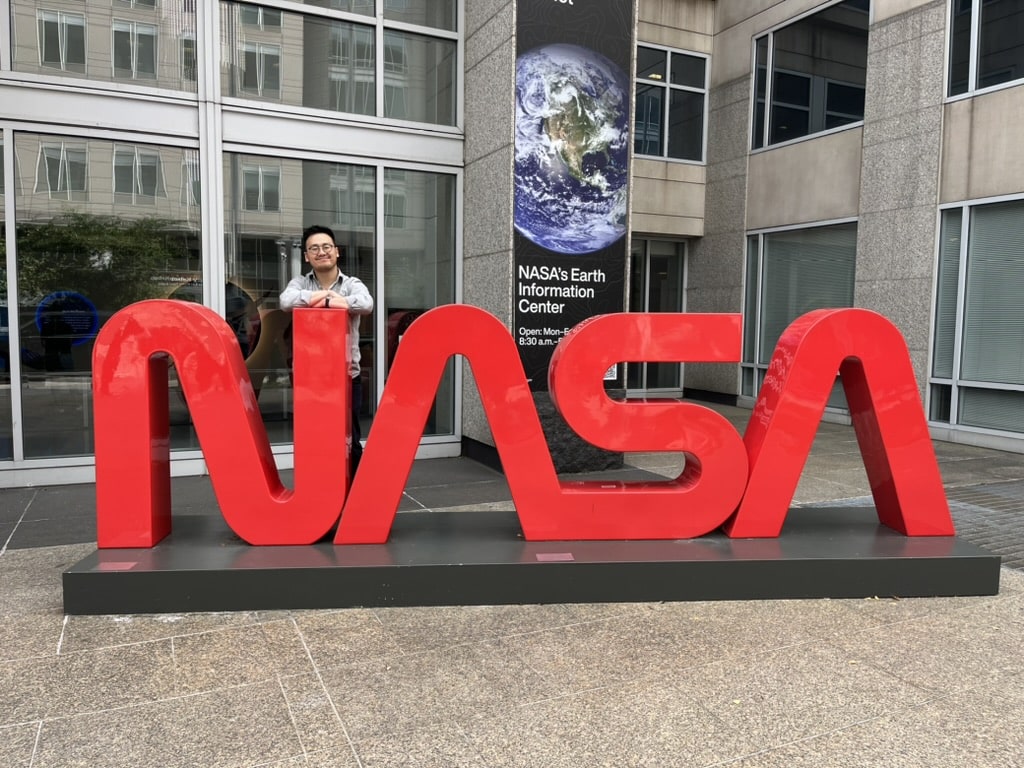
This summer, Bochu interned with NASA’s Scientific Computing division, where he built an AI agent that retrieves, summarizes, and synthesizes mission-critical information from years of technical documents.
“In short, I built a digital librarian. Instead of sifting through documents one at a time, NASA employees can get a direct answer that pulls from and cites relevant sources,” he explains. “I owned the project from user research to prototype to launch — interviewing users, designing wireframes, building a prototype, and deploying a working demo via Flask and React.”
He was shocked to get the call — NASA received north of 180,000 intern applications this year. “I later found out they were interested in my track record of shipping technology that’s usable and, well, used — experiences like pinpointing user needs and managing organizational change.”
How Duke DTI Prepared Him for NASA
Bochu credits Duke’s DTI curriculum for preparing him to navigate the challenges of his internship. “DTI instills a crisp, clear awareness that product development isn’t a linear path,” he says. “My first prototype at NASA fell on its face during user testing. One of my takeaways from DTI, and reinforced by my NASA mentors, is that we can update our assumptions at any point — progress is measured by units of learning.”
This perspective paid off. Excitement began to build as later versions of the product keyed in on real pain points. “Word spread quickly,” he shared. “A couple of weeks later, I found myself in the Space Operations Center, demoing the product for the Director of the International Space Station.”
What stuck with him most from DTI? “Methods and frameworks are just tools. The real magic is in cultivating judgment and humility — to say, ‘We were wrong, but now we know something about getting it right.’”
Researching Bias in AI and Making Data Human-Centered
Bochu’s curiosity extends beyond internships. As a computational media researcher at Duke’s Culture I/O Lab, he explored how AI models interpret identity and reproduce bias in visual representations. Using Stable Diffusion XL, he generated thousands of portraits based on single-word social labels — from “leader” to “drug dealer” — and created composite images to visualize bias. View the project here.
This semester, he’s working in the TRUST Lab, focusing on using small embedding models to investigate how AI concepts have changed over time. “It’s a bit meta: using AI methods to investigate the history of AI,” he said. “One of our goals is to show that AI’s development has always been shaped by many different schools of thought, methods, and philosophies. We want to open that broader landscape — an aperture wider and more inclusive than the dominant narrative about AI’s future.”
DTI’s philosophy has shaped Bochu’s research approach. “I’ve learned to ask: ‘So what? Who cares? What changes?’ It’s pushed me to think about research like a designer — how do we transform insights into what’s usable, actionable, and meaningful?”
Looking Ahead: Purpose-Driven Product Innovation
Bochu’s career aspirations lie at the intersection of product, prototypes, and purpose. “I want to build useful things that have never existed before — for pressing needs,” he says.
So far, that mission has led him from impact investing to space. “I’m excited to keep following this thread — wherever it leads. The problems are too interesting to do anything else.”