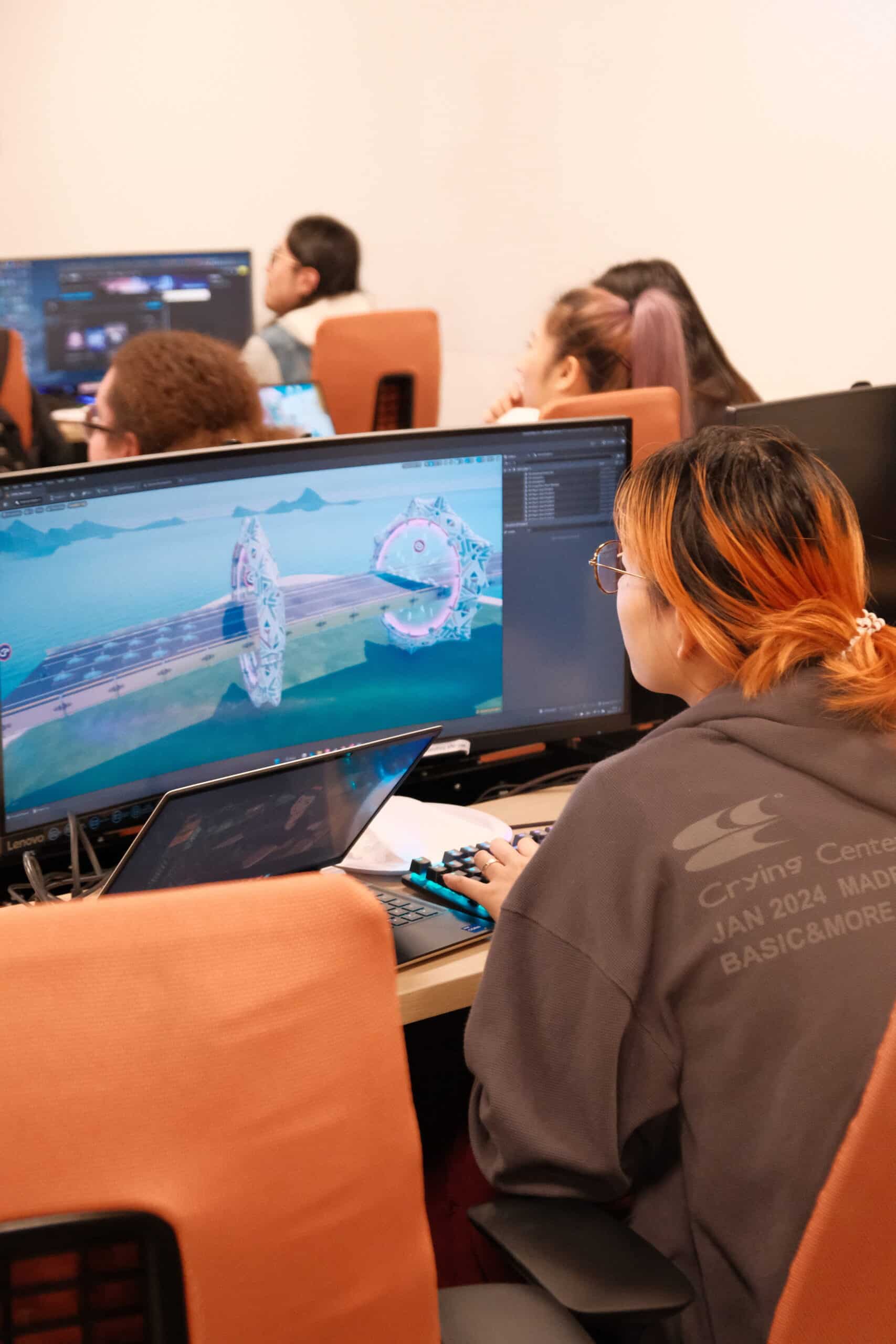
Masters in Game Development, Design & Innovation (MEng)
Design, develop and launch games in a studio environment at Duke. The Masters in Game Development, Design & Innovation (GDDI) is a Master of Engineering (MEng) where you’ll build expertise in everything from C# and C++ to leading game engines, UX and storytelling. This MEng combines the creative focus of a masters in game design with the technical depth of a masters in video game development. Graduate with a professional portfolio and the skills to join an AAA or indie studio.
Masters in Game Development, Design & Innovation (MEng)
Design, develop and launch games in a studio environment at Duke. The Masters in Game Development, Design & Innovation (GDDI) is a Master of Engineering (MEng) where you’ll build expertise in everything from C# and C++ to leading game engines, UX and storytelling. This MEng combines the creative focus of a masters in game design with the technical depth of a masters in video game development. Graduate with a professional portfolio and the skills to join an AAA or indie studio.
Take your game from idea to publishing-ready over two years
1
Internship
An intensive industry experience
Nearly 90%
of Duke Master of Engineering graduates find employment or further education within 6 months of graduation
Choose Your Avatar With Duke’s Masters in Game Development, Design & Innovation
There are a lot of roles to play in the game industry, and this masters in game development helps you step into the one you want: designer, developer and/or leadership roles. You’ll work on a two-year capstone game-design project in Duke’s studio-style program. You’ll also hold a professional internship to gain work experience and connect with industry players. At Duke, you’ll graduate ready to build, iterate and launch games — with a proven track record behind you.
This program is an excellent fit if you:
Come from a variety of STEM backgrounds OR have basic programming skills and demonstrated interest in game development from other domains such as: Game Design, Digital Art, Animation, Technical Art, UX, HCI, Interaction Design, Cognitive Science, Psychology, Sociology, Human Factors, Architecture, Industrial Design, Spatial Design, Narrative, Writing and Media Studies
Want to strengthen skills in programming, design principles, user experience and narrative
See yourself as a game developer and the kind of teammate who can grow into production and team leadership
Come with some background knowledge OR want to take the optional pre-program bootcamp (summer)
We welcome you, no matter your level of experience. We will transform you into a multi-faceted leader, one that is able to use technology to design, develop and innovate. You’ll be prepared to join an AAA or an indie studio and to create serious games in fields like education, health care, and science. Join us!
Ernesto EscobarExecutive Director, Game Development, Design & Innovation
Curriculum Overview
This program replicates a game studio environment. You will work as part of a team on a robust game project over two years, taking your game from ideation to execution. Prepare to work for AAA and indie studios or to create serious games in fields like education, health care and scientific exploration.
In year one, you’ll focus on core programming and game development courses. In year two, you are encouraged to take optional electives in addition to your two required electives.
GAMEDSGN 503: Pre-Program Bootcamp (Optional for Fall 2026)
GAMEDSGN 510: Programming for Game Development
GAMEDSGN 511: Software Engineering & Systems for Game Development
GAMEDSGN 520: Fundamentals of Game Development
GAMEDSGN 521: Advanced Game Development
GAMEDSGN 530: Critical Analysis of Video Games
GAMEDSGN 589: Game Development Capstone
MENG 540: Management of High Tech Industries
MENG 570: Business Fundamentals for Engineers
MENG 550: Master of Engineering Internship/Project
MENG 551: Master of Engineering Internship/Project Assessment
EGR 490: Career Strategy and Design
Students are encouraged to take as many GAMEDSGN electives as possible during the fall term of their second year. Elective options change each year but may include:
Game Engine & Tools Development
Artificial Intelligence in Games
3D Animation & MoCap
Networking & Multiplayer
Virtual & Augmented Reality
Designing Immersive Experiences
UX & UI Development
Serious Games: Leveraging Game Technology to Address Real-World Issues
Mobile Game Development
Qualified students also have access to a wide range of graduate electives across Duke’s Institute for Enterprise Engineering and the wider Pratt School of Engineering, including:
Artificial Intelligence
Biomedical Engineering
Cybersecurity
Design Technology & Innovation
Electrical & Computer Engineering
Financial Technology
First Year – Core Courses in C++ & Unreal Engine
Summer
Fall
Spring
GAMEDSGN 503: Pre-Program Bootcamp – Optional for Fall 2024 (0 credits)
GAMEDSGN 510: Programming for Game Development (3 credits)
GAMEDSGN 511: Software Engineering & Systems for Game Development (3 credits)
GAMEDSGN 520: Fundamentals of Game Development (3 credits)
GAMEDSGN 521: Advanced Game Development (3 credits)
GAMEDSGN 530: Critical Analysis of Video Games (3 credits)
MENG 540: Management of High Tech Industries (3 credits)
EGR 590: Career Strategy and Design (1 non-tuition-bearing credit)
Second Year – Technical Electives & Capstone
Summer
Fall 1
Spring
MENG 550 & MENG 551: Industry Internship/Project (6 non-tuition-bearing credits)
Technical Elective #1 (3 credits)
GAMEDSGN 589: Game Development Capstone (3 credits)
Technical Elective #2 (3 credits)
Optional Technical Elective(s) (3 to 6 credits)
MENG 570: Business Fundamentals for Engineers (3 credits)
Programming fundamentals and implementation skills, including C# and C++
How to build with leading game engines like Unreal and Unity
Core development and design principles that guide great gameplay and systems
How to integrate art and storytelling into a cohesive user experience
How to collaborate within and lead dynamic design and development teams
Why Duke?
The masters in Game Development, Design & Innovation stands out because Duke pairs serious engineering strength with a culture of creativity and collaboration. You’ll learn in a community where builders, designers, storytellers and innovators work side by side — where game development can make a bigger impact across fields like education, health care and training. As a student in Duke’s Game Development, Design & Innovation (GDDI) MEng, you’ll gain these advantages:
Duke replicates a real game studio, emphasizing hands-on, project-based work that helps you graduate with playable builds, design artifacts and a stronger professional portfolio. Work on industry-sponsored projects and practice how teams scope, iterate, test and launch.
At Duke, game development doesn’t live in a bubble. Collaborate with students and faculty from history, art, medicine, business, psychology, policy, physical education, engineering and more. You can explore how interactive experiences support meaningful outcomes and help address societal challenges.
Duke’s masters in Game Development, Design & Innovation faculty take innovation seriously, and mentorship is part of the experience. You’ll learn with guidance from leaders who understand both the craft and the career landscape. You’ll also interact with AAA and indie studios in the growing Research Triangle Region such as Epic Games, Insomniac Games, Red Storm Entertainment (Ubisoft), Virtual Heroes, Squanch, Funcom, Elephant Mouse, BitMonster, Prologue, Puny Human, Spark Plug, iMagic, Mighty Rabbit, Imangi Studios and more.
Hear from Our Students
I learned that testing, getting feedback and iteration is essential to creating a good product. As an engineer, learning how to take feedback from clients and apply them in a project is an essential skill that I will use for the rest of my career.
Developers can earn a $108,000 salary in the fast-growing $2 billion games industry
The game industry has seen tremendous growth, including rapid expansion across new platforms and diverse markets. There is a critical need now for well-trained and experienced talent. Game development requires a complex mix of creative and technical abilities. This graduate program provides a foundation of skills and hands-on experience to create a talent pipeline well-positioned to thrive in this complex ecosystem
Rob DentonDuke Engineering Graduate, Co-Founder & COO, Loric Games, Founder & President, Broadsword Online Games
Career Outcomes With a Masters in Video Game Development, Design & Innovation
Games are no longer “just entertainment.” They power everything from blockbuster releases to interactive learning, simulation and training. Studios and adjacent industries need people who can build game experiences. The global video game market is projected to grow from $299B to $601B by 2030 (about 12% CAGR).
A masters in video game development from Duke arms you with proof you can do the work: professional project portfolio, team-based production experience and the ability to connect engineering with player experience. This isn’t just a masters in video game development program. It’s a place to build work that can live in the world.
Employment Settings for Duke GDDI Graduates
AAA and indie game studios
Game tech and platform companies
Interactive media and entertainment teams
Simulation, training and serious games organizations (education, health care, workforce training)
UX and player experience teams supporting digital products
Roles for a Masters in Game Development, Design & Innovation
Our grads are career-ready for a wide range of roles:
Duke alumni boast strong outcomes. Nearly nine out of 10 Duke Engineering master’s graduates start work or continue education within six months. All alumni have access to specialized 1:1 career coaching, industry workshops and an exclusive job board, supported by a 200,000+ alumni network.
With the creative rigor of a masters in game design and the technical depth of a masters in video game development, this master’s makes you competitive for studio roles that value systems thinking, iteration and cross-disciplinary collaboration.
FAQs for the Masters in Game Development, Design & Innovation
Here are some Frequently Asked Questions (FAQs) to help you decide whether the Game Development, Design & Innovation Master of Engineering is right for you.
You can pursue a wide range of roles across game studios and adjacent industries that use interactive technology. Many graduates move into positions like gameplay engineering, tools/engine development, technical design, systems design, production and player experience (UX).
GDDI also prepares you for opportunities beyond entertainment. Because the program supports “serious games” applications, you can apply your skills in areas like education, health care and training, building interactive experiences that teach, simulate or improve real-world outcomes.
Game design focuses on what the player experiences (mechanics, systems, pacing and UX) and how the game feels moment to moment. Game development focuses on building the experience (programming, implementation, performance and tools) and the technical pipeline that makes the game run.
With our masters in Game Development, Design & Innovation, you won’t have to choose one focus. The program is built to connect design decisions to real builds. You graduate with the ability to collaborate across disciplines, communicate trade-offs and launch unique games that hold up in production.
Yes. Students come from a variety of STEM backgrounds, and the program is designed to support motivated learners at different starting points. What matters most is your willingness to learn quickly, collaborate and iterate, because that’s how game teams work in the real world.
If you’re transitioning into game development, GDDI can help you build the technical foundation, design fluency and portfolio-ready work that employers look for when hiring. Our masters in video Game Development, Design & Innovation also offers an optional bootcamp to help get you up to speed the summer before your program starts.
You’ll learn programming skills that support modern game production, including languages like C# and C++, and you’ll work with a variety of leading game engines. Beyond tools, the program emphasizes principles that transfer across platforms, like systems thinking, iteration, performance awareness and how to design with the player experience in mind.
That way, you graduate ready to adapt as engines and platforms evolve.
Yes. You’ll complete a capstone project that takes your game from idea to execution. You’ll also complete an intensive internship experience with one of the many leading companies who want to work with Duke students.
There are diverse AAA and indie studios in the growing Research Triangle Region such as Epic Games, Insomniac Games, Red Storm Entertainment (Ubisoft), Virtual Heroes, Squanch, Funcom, Elephant Mouse, BitMonster, Prologue, Puny Human, Spark Plug, iMagic, Mighty Rabbit, Imangi Studios and more.
Together, those components help you graduate with proof of what you can build, plus real-world experience you can bring up in interviews.
Take the Next Step With Duke’s Masters in Game Development, Design & Innovation
Learn to design, build and launch games in a studio-style environment. Strengthen your skills in programming (including C# and C++) and leading game engines, UX and storytelling. Because our masters in game development emphasizes hands-on projects, you’ll graduate with practical experience and portfolio-ready work that you can show employers.
Ready to build it at Duke? Request more information or start your application today.
Duke’s Master in Game Development, Design & Innovation celebrated its first graduating class with a spring Demo Day showcasing the program’s studio-based approach to game development.
Duke’s MEng in Game Design, Development, and Innovation program connected with an alumnus to use a quirky, yellow, handheld game console to teach iterative design.
Duke Engineering’s co-op program embeds master’s students in full-time professional roles for up to a year, building the skills, network and experience that top employers are looking for.
A new DHS rule (Duration of Status) affecting F-1 and J-1 students and scholars takes effect September 15, 2026. Join Duke Visa Services to learn: What is changing Who is […]
3:00 pm – 3:00 pmVirtual
Cookie Consent
This website uses cookies as well as similar tools and technologies to understand visitors' experiences. By continuing to use this website, you consent to Duke University's usage of cookies and similar technologies, in accordance with the Duke Privacy Statement.
Cookie Preferences
Manage your cookie preferences below:
Essential cookies enable basic functions and are necessary for the proper function of the website.
Name
Description
Duration
Cookie Preferences
This cookie is used to store the user's cookie consent preferences.