
Master of Engineering in Financial Technology

Break into engineering in finance with Duke’s FinTech Master of Engineering (MEng) degree. You’ll build the quantitative and technical foundation behind modern financial technology, from computing fundamentals to blockchain, cryptocurrency and digital assets. Innovation in FinTech is driven by AI, machine learning, blockchain and advanced engineering methods. Learn how they power pricing, risk, trading and financial decision-making. You’ll blend computing, data and markets knowledge. With a financial engineering masters from Duke, you’ll graduate ready for in-demand roles. An accelerated schedule and masters in financial engineering online option are also available.

12-29 months

to complete on-campus or online

7

Technical Courses

to build core skills for engineering in finance

2

Business Courses

to strengthen leadership and financial decision-making

1

Capstone Project & Internship

that build your professional work portfolio

Is Duke’s Financial Engineering Masters Right for Me?

If you’re interested in engineering in finance, Duke Pratt’s FinTech MEng may be for you. This program is for students and professionals who want a financial engineering masters experience that feels practical, career relevant and grounded in the realities of modern markets while also looking to the future.

Consider applying if you’re:

  • An economics or business graduate who wants to add technical depth and learn how emerging technologies are reshaping finance.
  • An engineering, computer science, physics, math, statistics or econometrics graduate who wants to apply strong quantitative skills in finance and FinTech.
  • An ambitious working professional looking for flexibility with a masters in financial engineering online option that fits your schedule.
  • A high-achieving Duke undergraduate interested in earning your bachelor’s and a FinTech master’s in just five years, with a clear, efficient path to an advanced credential.
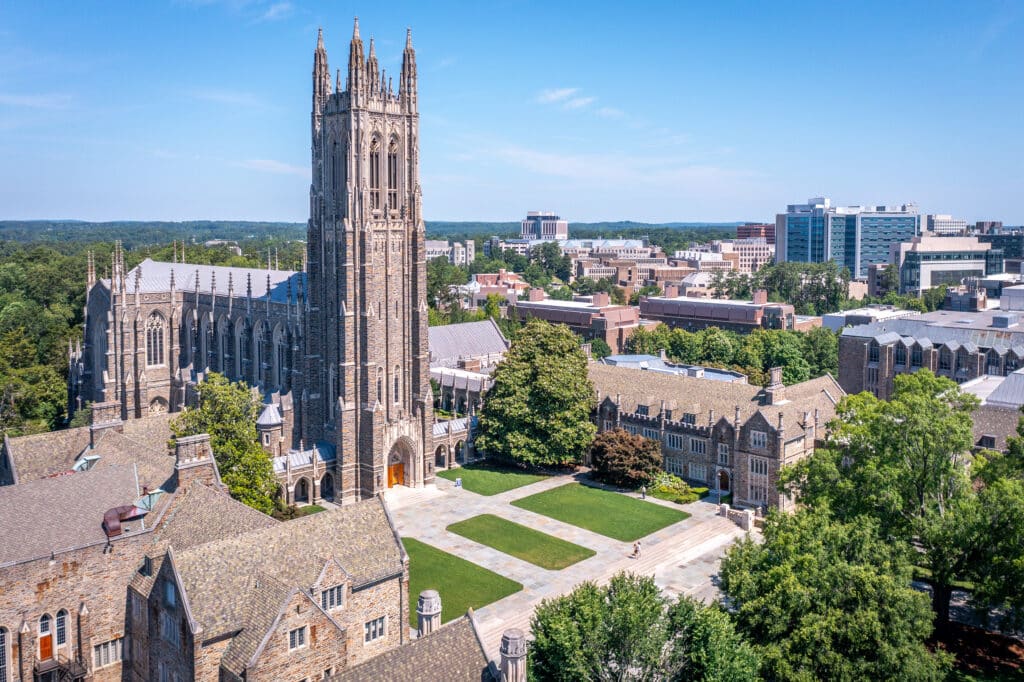
Duke Engineering in Finance (FinTech) master’s students gather outside Duke Chapel for a class photo
Christian Hollar

Pursuing a master’s degree in finance technology engineering was one of the best decisions I’ve ever made. My degree allowed me to build on my technical knowledge and gain a deeper understanding of how emerging technologies are transforming financial systems. Companies will need people who understand finance, computer science, mathematics, and artificial intelligence — skills that define a fintech engineer. One of the most challenging aspects of my fintech program was having to leave it.

Christian Hollar, MEng in FinTech, 2025 Lead Software Engineer, Depository Trust & Clearing Corporation

Why a Master of Engineering?

You may be considering a traditional FinTech master’s, business analytics program or MBA with a FinTech concentration. One of the key differences that a Master of Engineering offers is that the program is about building, not just managing or analyzing FinTech. MBAs focus on management, leadership and strategy. Our MEng focuses on technical depth, applied systems and how financial technology actually works under the hood.

  • Engineers design and deploy systems.
  • Engineers build models, pipelines, infrastructure and protocols.
  • Engineers work at the level of architecture, not just strategy.
Golden luminaries and blue tree lights around Duke West Campus

Curriculum Overview

  • View course descriptions

  • The culminating experience of the Duke FinTech program. Students in teams design and build FinTech solutions initiated by industry needs or pursue their own startup ideas.

    View course information

  • A required internship is an excellent way to gain valuable experience. Although students are responsible for finding their own internships, Duke provides a dedicated career development team to help.

    Part-time students can receive credit for applying what they learn at work, or opt to complete a project.

    Note: The 12-month track does not require an internship.

    View course information

  • On-campus students participate in a seminar series, in which they learn directly from industry leaders

    Online students participate in virtual seminars and also attend Fall residency on the Duke campus during which they participate in industry talks and classes, and meet students and faculty

Typical Study Plan

  • The Duke FinTech Master of Engineering can be completed on-campus in:

    • 3 semesters—Take an elective as a fourth course in Spring 1 or Fall 2 full-time, or
    • 4 semesters—Take a final elective in Spring 2 as a part-time student
    Industry Technical Core Electives Internship
    Year 1 – First Semester
    • MENG 540: Management of High-Tech Industries
    • FINTECH 501: Seminar and Workshop
    • FINTECH 510: Programming for FinTech
    • FINTECH 520: Financial Institution Products & Services
       
    Year 1 – Second Semester
    • MENG 570: Business Fundamentals for Engineers
    • FINTECH 512: Software Engineering for FinTech
    • FINTECH 522: Asset Pricing and Risk Management
    • Elective
     
    Year 1 – Summer Session
         
    • MENG 550: Internship
    Year 2 – Third Semester
     
    • FINTECH 502: FinTech Capstone
    • Elective
    • Elective
    • Elective
    • MENG 551: Internship Assessment
    Year 2 – Fourth Semester
       
    • Elective
     
  • The Duke FinTech Master of Engineering can be completed in 12-months via the accelerated track.

    Note: A minimum of 2 years of work experience is required to be admitted into this track. The 2 years of work experience count for the internship requirement.

    Industry Prep Core Technical Core Electives Internship
    Summer Session
    • MENG 540: Management of High-Tech Industries
     

    • FINTECH 510: Programming for FinTech
    • FINTECH 520: Financial Institution Products & Services
       

    • MENG 550: Internship
    First Semester
    • MENG 570: Business Fundamentals for Engineers
    • FINTECH 501: Seminar and Workshop
    • FINTECH 512: Software Engineering for FinTech
    • FINTECH 522: Asset Pricing and Risk Management
    • Elective
     

    • MENG 551: Internship Assessment
    Second Semester
     
    • FINTECH 502: FinTech Capstone
    • Elective
    • Elective
     
  • The Duke FinTech Master of Engineering can be completed online in five semesters.

    Industry Technical Core Electives Internship or Mentored Project Residency
    Year 1 – First Semester
     
    • FINTECH 501: Seminar and Workshop
    • FINTECH 510: Programming for FinTech
    • FINTECH 520: Financial Institution Products & Services
       
    • Residency
    Year 1 – Second Semester
    • MENG 540: Management of High-Tech Industries
    • FINTECH 512: Software Engineering for FinTech
    • FINTECH 522: Asset Pricing and Risk Management
         
    Year 1 – Summer Session
         
    • MENG 550: Internship
     
    Year 2 – Third Semester
    • MENG 570: Business Fundamentals for Engineers
     
    • Elective
    • MENG 551: Internship Assessment
     
    Year 2 – Fourth Semester
       
    • Elective
    • Elective
       
    Year 3 – Fifth Semester
     
    • FINTECH 502: FinTech Capstone
         

Masters in Financial Engineering Online vs. On Campus

The choice of online or on campus is up to you. All students take the same courses, learn from the same faculty and earn the same Duke degree. 

On-Campus (Traditional Track)OnlineOn-Campus (Accelerated Track)
Minimum time to degree17-22 months24-29 months12 months
Summer internship or projectInternshipProjectWaived (requires minimum 2 years of work experience to be admitted)
Class experienceClass attendance at Duke — in-person and virtual interaction with faculty and peersLive and recorded classes — virtual interaction with faculty and peersClass attendance at Duke — in-person and virtual interaction with faculty and peers
Seminars & workshopsParticipation in a scheduled seminar seriesParticipation in seminar series and an in-person residency on the Duke campusParticipation in a scheduled seminar series
Academic advisingIn-person and virtual interaction with a faculty advisorVirtual interaction with a faculty advisorIn-person and virtual interaction with a faculty advisor
Career services & professional developmentSupport from a team of career services professionalsSupport from a team of career services professionalsSupport from a team of career services professionals

Why Duke FinTech?

Duke’s FinTech MEng stands out because it’s built for the real intersection of technology, data and markets. This isn’t a theoretical “finance plus a little coding” experience. You’ll learn in a community where engineers, quantitative thinkers and business-minded builders collaborate on solutions that reflect how modern finance works. This engineering in finance program offers:

  • Are you looking for a masters in financial engineering online or on campus? Choose from a Traditional campus track (17-22 months), an Accelerated on-campus track for professionals with 2+ years of work experience (12 months), or an Online track (24-29 months).

  • You can earn while you learn at Duke. You can complete this program online while working full time and apply what you learn the very next day at work. The online degree is designed for professionals who want to advance, not pause.

  • A strong financial engineering masters degree should leave you with proof of your skills. Duke’s capstone project or internship option helps you create a professional portfolio to show what you can do. Plus, go beyond case studies and work directly on live projects in areas like fraud detection, payments and DeFi. Graduate with work you can show, explain and defend in interviews. 

  • Duke pairs technical training with business, policy and ethical training so you can translate models and analysis into strategic decisions. Unlike business school programs, Duke’s FinTech master’s builds technical depth in AI, blockchain and cybersecurity. You’ll also learn about wallets, cryptocurrency and smart contracts. This combination sets you up for greater career growth over time.

  • Duke is collaborative by nature. You get access to faculty guidance and program support that help you sharpen your direction faster. That guidance helps you refine technical skills and plan your next career move. Our engineering in finance program faculty includes experts from Duke’s Pratt School of Engineering, Law School and Department of Economics.

Jimmie Lenz profile image

With outstanding faculty from engineering, law, economics and business, the Duke FinTech Master of Engineering program is developing professionals with the skills to lead the next generation of innovation.

Jimmie Lenz Lafitte Director and Executive in Residence, FinTech Program

Careers & Outcomes With a Financial Engineering Masters

Roughly nine in 10 FinTech MEng grads are employed or continuing their education within six months.

Common Areas of Alumni Expertise

  • Quantitative analysis and trading
  • Credit, liquidity and risk management
  • Digital assets, crypto and distributed ledger technologies
  • Payment and transaction services
  • Asset management and hedge funds

Common Roles of Alumni

  • Quantitative Analyst/Financial Engineer
  • Algorithmic Trading or Quant Developer
  • Risk or Fraud Analytics Engineer
  • Data Scientist (Financial Services)
  • FinTech Product or Analytics Lead

Hear From Our Students

Headshot of Jason Dorman.

It’s abundantly apparent to me the program is very well designed to not only provide detailed knowledge of the current state of FinTech and Finance but will provide the tools and education necessary to be a part of building the future of the industry.

Jason Dorman FinTech Online Student, 2025
Read Jason’s story »
Olivia Shen

I chose Duke for my master’s degree in FinTech because of Duke’s worldwide reputation as well as its strong alumni network.

Olivia Shen Duke FinTech Master’s Student

Hear From a FinTech Leader

The Duke FinTech program is focused on preparing graduate students for an exciting career in an industry that is growing, is complex in its composition, consistently innovating new products and services and serves an important part in the formation of capital and investments that impact individuals livelihood.

Craig Messinger Vice Chairman, Virtu Financial

FAQs for the Engineering in Finance (FinTech) Master of Engineering

Here are some Frequently Asked Questions (FAQs) to help you decide whether Duke’s FinTech MEng is right for you.

  • Financial technology, or FinTech, describes the innovative applications of computer software and networks, and other information technology, on financial institutions and markets. This includes technology enabling digital currencies (such as cryptocurrencies), digital assets, financial process automation, wealth management and trading, robotic advising, payment and transactions, financial data analysis, credit and lending and much more.

  • Yes. You can complete the FinTech MEng online or on campus, and you’ll earn the same Duke Pratt degree. Online students typically follow a longer pacing schedule.

  • Most on-campus students finish in 12-22 months, while the online option typically takes 24-29 months, depending on course load.

  • Online students may request approval to complete a project in lieu of an internship, if desired.

  • The program requires 30 credits, which is typically 10 courses.

    • Business/Finance
    • Math
    • Engineering
    • Computer Science
    • Economics
  • In 2024:

    • 877 Applied
    • 177 Admitted
    • 108 Enrolled
    • 44% Female
    • 23 Average Age
    • 3.7-3.9 GPA
    • Mid-50 Percentile

Take the Next Step With Duke’s Financial Engineering Masters

Build the technical and quantitative skills behind modern finance. In Duke’s engineering in finance (FinTech) MEng, you’ll strengthen your ability to work with data, models and real market problems, launching solutions that teams can use. This financial engineering masters translates directly to FinTech and financial services roles. This flexible program offers a traditional or accelerated on-campus option, or a masters in financial engineering online for working professionals.

Ready to get started? Request more information or start your application today.

Digital Assets @ Duke Conference

Join key industry players, regulatory experts and select researchers for two days of rigorous debate, discussions and education.

Coffee & Crypto Podcast

News

Duke Engineering's co-op program embeds master's students in full-time professional roles for up to a year, building the skills, network and experience that top employers are looking for.
3/23 Pratt School of Engineering

The Duke Co-op Advantage

Duke Engineering’s co-op program embeds master’s students in full-time professional roles for up to a year, building the skills, network and experience that top employers are looking for.

Jimmie Lenz, executive director of the FinTech master's program, leads an industry panel at the Digital Assets at Duke conference in 2024.
1/27 Pratt School of Engineering

How Duke’s Online FinTech Program Puts People First

More than a flexible degree, the online FinTech program at Duke prioritizes applied learning and deep industry engagement. Students gain hands-on experience, personal support and access to the full Duke community—wherever they’re learning from.

Luca Antonacci Headshot
11/21/25 Pratt School of Engineering

Accelerated Success: Luca Antonacci

Duke University’s Master of Engineering in Financial Technology (FinTech) program is known for producing graduates who go on to become leaders in financial innovation. Among the current students preparing to follow that path is Luca Antonacci, a student in the inaugural cohort of Duke FinTech’s accelerated program.

Events